
Menu

Choosing a tax prep provider is a personal decision, and it can have lasting effects beyond a single filing season. The person or service you work with will see sensitive financial details and guide decisions that affect your refund, balance due, and future filings.
That’s why it’s worth taking time to evaluate your options instead of choosing based on convenience alone. A reliable provider should be knowledgeable, transparent, and willing to explain what they are doing and why. Below are several areas to consider when deciding who should help you file your 2025 taxes in 2026.
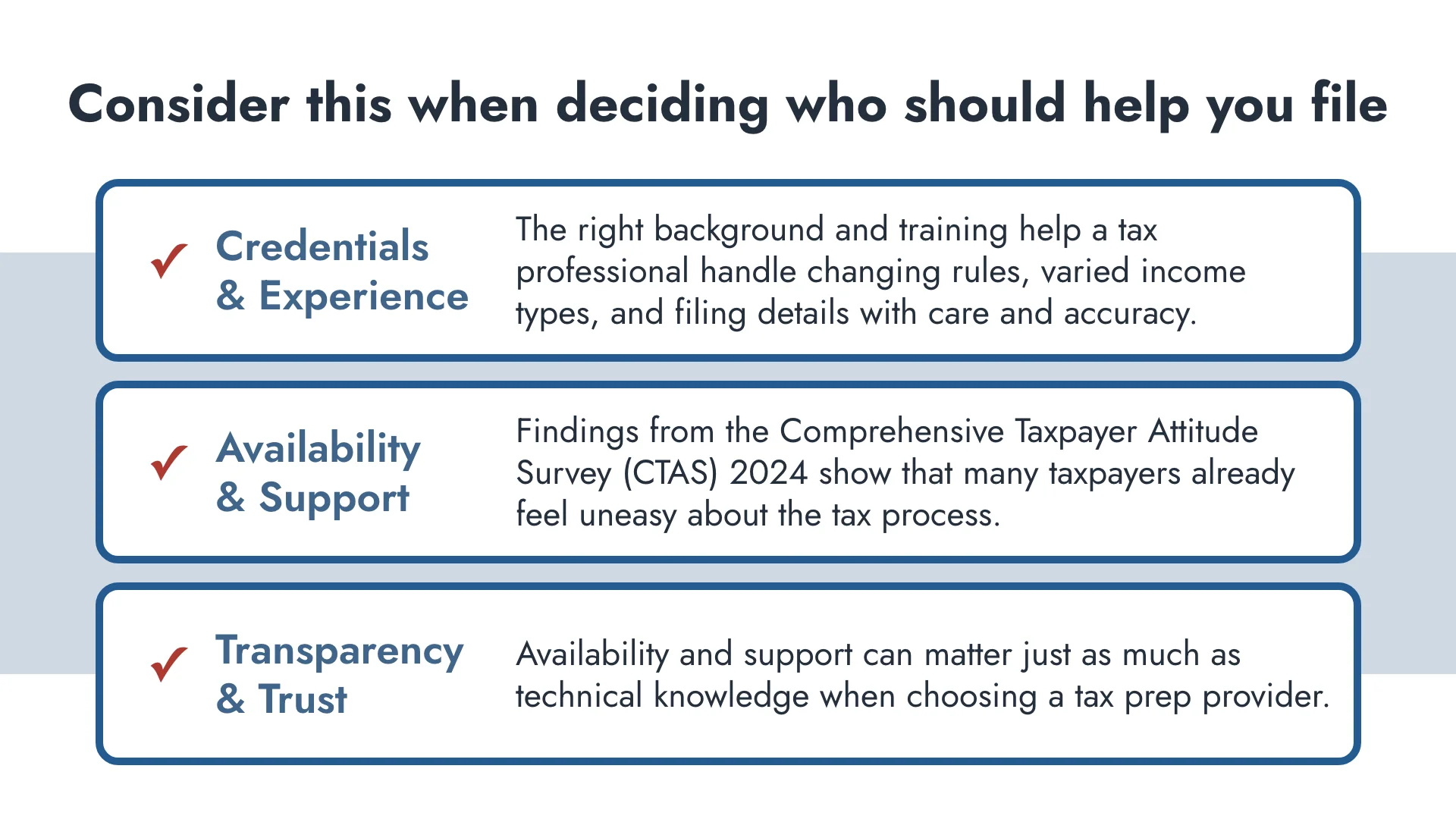
Credentials and experience matter because tax preparation involves more than filling out forms. The right background and training help a tax professional handle changing rules, varied income types, and filing details with care and accuracy.
Anyone who prepares or assists in preparing federal tax returns for pay must have a valid 2026 Preparer Tax Identification Number (PTIN) before preparing returns. This requirement applies to all paid preparers, including enrolled agents.
A PTIN is a unique eight-digit number issued by the IRS and must be included on every return a paid preparer completes. If someone charges for tax preparation and does not have a valid PTIN, that is a serious concern and a reason to look elsewhere.
Not all tax returns are the same. Some preparers mainly handle basic W-2 filings. Others regularly work with self-employed income, rental properties, or investment reporting. Ask whether the preparer has worked with situations like yours. This matters for gig workers, families with multiple credits, retirees, and anyone with changes from prior years. Familiarity with your type of return can help avoid missed forms or misunderstandings.
Federal taxes are only part of the picture. State and local tax rules can vary widely, especially for people who have moved, worked in multiple states, or earned income across state lines. A tax prep provider should understand how state rules interact with your federal return. This is especially important for self-employed workers, remote employees, and those who relocated during 2025.
Findings from the Comprehensive Taxpayer Attitude Survey (CTAS) 2024 show that many taxpayers already feel uneasy about the tax process. Trust in the IRS helping people understand their obligations dropped from 68% in 2022 to 63% in 2024, and trust in fair enforcement also declined. Satisfaction with personal IRS interactions fell from 79% to 75% over the same period.
These shifts highlight why tax preparers must work harder to clearly explain choices, set expectations early, and help clients feel comfortable every step of the way.
In the sections below, we’ll discuss just some of the ways tax preparers can help build trust and make the tax filing process easier for taxpayers in the United States.
What you pay for tax preparation services can vary based on a lot of different things. These include the pricing model used, the complexity of the return, add-on services, and regional market rates. Some preparers charge a flat fee, while others bill by the hour. Add-on services can raise the cost. Examples of add-on services include audit support, amended return preparation, or help with prior-year filings.
The type of return also affects pricing. A basic Form 1040 usually requires less time than a return with Schedule C for business income or Schedule D for capital gains. A trustworthy provider explains pricing before work begins and answers questions about what is included.
A tax preparer should be able to explain how credits, deductions, and filing status choices affect your return. You should understand why the refund amount changed or why a balance is due. If explanations feel rushed or vague, that’s a sign to slow down and ask more questions. Clear explanations help you feel informed rather than confused once your return is submitted.
Taxes are complex, but explanations should not be. A good preparer avoids jargon and explains concepts in everyday terms. You should feel comfortable asking questions without feeling rushed or dismissed. If someone talks over you or avoids direct answers, that may not be the right fit.
Availability and support can matter just as much as technical knowledge when choosing a tax prep provider. Questions don’t always stop once a return is filed, so it helps to know what kind of access and follow-up support will be available afterward.
Tax season does not always end on filing day. You may have questions after submitting your return or notice something that doesn’t look right. Ask whether support is available after filing and how long that support lasts. Some services close once tax season ends, while others remain available throughout the year.
Amendments happen more often than many people realize. The Internal Revenue Service receives an estimated 4 million amended returns each year. An amended return is filed using Form 1040-X, which allows taxpayers to correct or update a previously filed federal return. Having a tax prep provider who offers support with amendments can save time and reduce frustration if changes are needed.
Common reasons taxpayers file an amended return include:
Access to past returns can be helpful when applying for loans, financial aid, or future tax filing. Ask how long records are kept and how you can obtain copies if needed. Digital access can be especially helpful if you move or change providers later.

Red flags are warning signs that something may not be right. When choosing a tax prep provider, paying attention to these signals can help you avoid mistakes, added costs, or future problems. Being aware of what to watch for allows you to step back, ask questions, and choose help that feels appropriate for your situation.
No tax preparer can promise a specific refund amount before reviewing your full financial picture. According to data from the Internal Revenue Service, for the week ending April 4, 2025, an estimated $211.080 billion would be refunded to American taxpayers, with an average direct deposit refund of $3,186.
That number is only an average. Your refund could be higher, lower, or you may not be due a refund at all. Be cautious of anyone who guarantees large refunds or claims they can “get you more” without reviewing your documents. Any refund due will depend on your tax withholding, income, credits that you may be due, and your unique tax filing details. You should also never feel pressured to take advances or refund-based products if they do not fit your situation or comfort level.
You should always receive a copy of your completed return and any supporting schedules. If a preparer does not provide documentation or cannot explain what was filed, that is a serious concern. Transparency matters when it comes to your financial records.
Credit Central provides tax preparation services designed to meet people where they are, whether filing feels familiar or overwhelming. One helpful option is a free estimate, which gives you a clearer picture of a potential refund before moving forward. When you are due a refund, there are no upfront fees for tax preparation. Instead, you can choose to have the preparation cost deducted directly from your refund after the IRS processes your return.
For those who want access to funds sooner, Credit Central also offers tax refund advances up to $7,500, based on eligibility. This option allows qualified filers to receive part of their expected refund before the tax season wait is over.
Getting started is easy. Use the tax branch locator on the Credit Central website to find the nearest location and schedule a time with a local team member who can walk you through the next steps.


